 Monarch.
ForgeAI / TOFU / custom AI automation for small business
What Does "Custom AI Automation" Actually Mean for a Small Business?
What "custom" AI automation actually means for a small business, how it differs from off-the-shelf tools, and what building one involves.
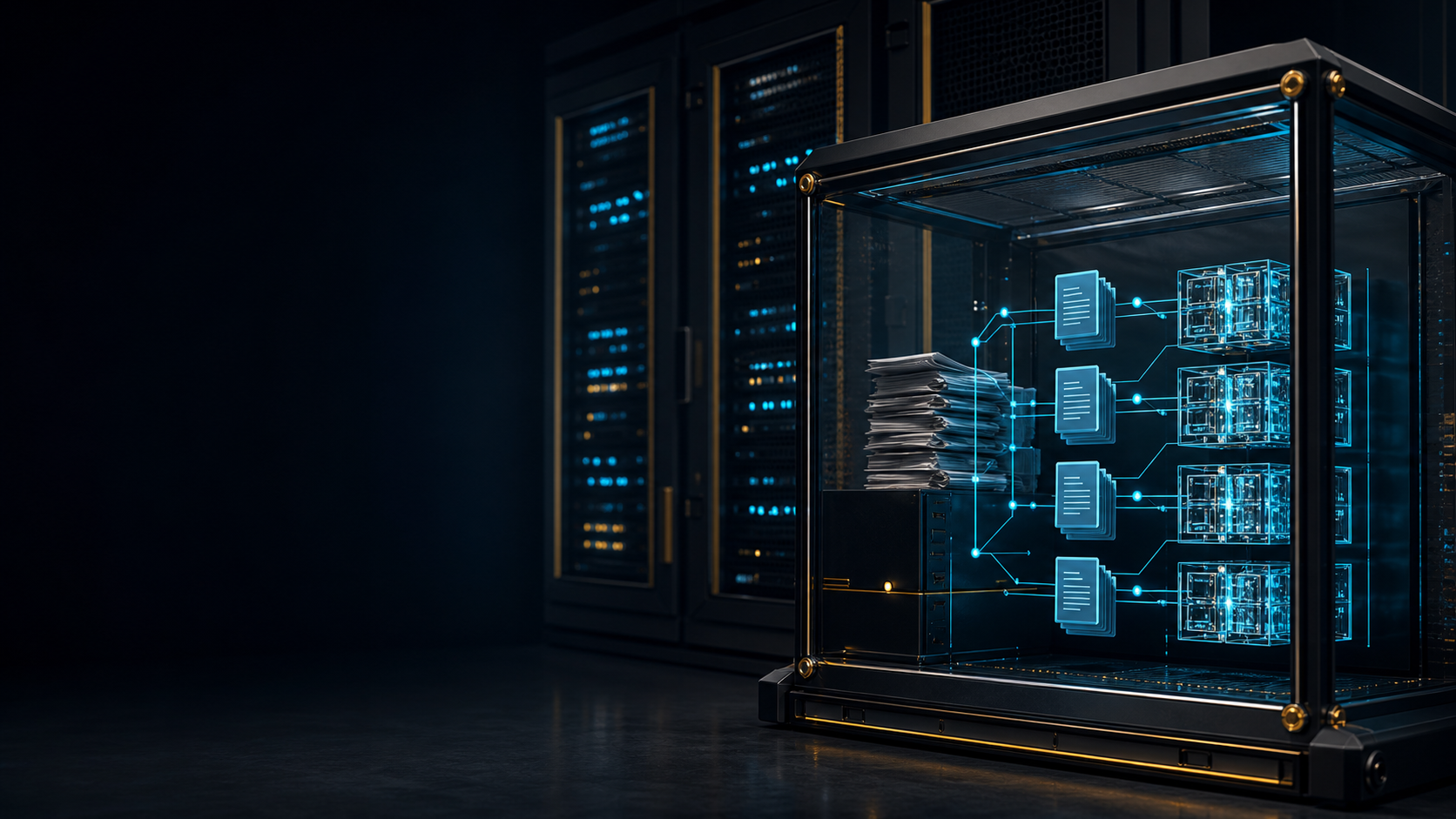
Custom AI automation means an AI system built around your business's own documents, workflows, and terminology, instead of a general-purpose tool you have to adapt yourself. For a small business, that usually means someone else does the configuration work: scoping which policies and processes the system should know, connecting it to your approved materials, and handing you something that already understands your operation before your team types a single prompt. An off-the-shelf AI tool asks you to do that adaptation on your own time, with your own trial and error.
What Is the Difference Between Custom AI Automation and an Off-the-Shelf AI Tool?
An off-the-shelf tool is built once and sold to anyone. It ships with general knowledge, a generic interface, and whatever default settings the vendor chose. You bend your workflow to match the tool, not the other way around: you write prompts that re-explain your business every time, copy in context the system doesn't retain, and work around features built for a hypothetical "average" customer that doesn't match yours.
Custom AI automation flips that relationship. Instead of configuring a generic product yourself, a vendor or implementation partner scopes the system around your actual SOPs, contracts, client records, or internal manuals before you ever touch it. The output looks similar on the surface (both might answer a question or draft a document), but the custom version already knows your return policy, your intake process, or your service terms, and the off-the-shelf version doesn't unless you tell it every time.
That distinction matters more than the word "custom" might suggest. It's not really about bespoke code. It's about who does the work of making the system relevant to your business: you, repeatedly, or someone who builds that relevance in once.
Why Would a Small Business Choose Custom AI Automation Instead of a Ready-Made Tool?
Most small businesses that look into AI start with a free or cheap tool, run into its limits fast, and then wonder whether something more tailored is worth the extra cost and commitment. Three practical reasons tend to push that decision toward custom automation.
The first is staffing. A small team configuring a general AI platform on its own needs someone who understands both the tool and the business well enough to translate one into the other, and most firms with fewer than five employees don't have a dedicated person for that. Census Bureau data from May 2026 (opens in a new tab) shows why this gap shows up in the adoption numbers: firms with 250 or more employees reported AI use of 37% as of early May 2026, and firms with 100 to 249 employees reported 32%, while firms with four or fewer employees stayed under 20% — and that smallest-firm figure barely moved between December 2025 and May 2026, even as larger firms kept climbing. Bigger firms have the staff to configure general tools themselves; many of the smallest firms don't, so a system that arrives already configured closes a gap that an off-the-shelf tool leaves open.
The second reason is consistency. A tool you reconfigure by hand, through prompts, drifts: different employees word the same question differently and get different quality answers back. A system built around your approved documents answers the same question the same way regardless of who asks.
The third is the information itself. Many small businesses don't want their contracts, client files, or internal procedures flowing through a general consumer AI product with unclear data handling. Custom automation can be scoped and deployed around exactly which documents go in, and where the resulting system runs, in a way that bolting your workflow onto a public chatbot never fully controls.
What Does Building Custom AI Automation Actually Involve?
The process looks less like software development and more like deliberate curation. A team decides which documents, processes, and terminology should inform the system (policies, SOPs, contracts, manuals, client records, training materials) and which should stay out. That scoping step is the actual "custom" part; it's a judgment call about what the business wants the system to know, not a line of code written from scratch.
From there, a vendor configures and tests the system against that approved material, then hands it to the business with a defined set of uses: internal question-answering, drafting, summarization, or looking up a process on demand, for example. As a working illustration of this approach, ForgeAI's deployment process (opens in a new tab) runs on hardware placed inside the customer's own environment and configured around whatever documents the team approves, with the business keeping control over what gets added, changed, or removed as things change later. Most installations of that kind finish within a single business day, though the timeline for any custom build depends on how much material needs scoping and how complex the approval process is.
What doesn't change, regardless of vendor, is that someone has to make the scoping decisions. A business that skips that step and just hands over everything it has isn't building custom automation: it's building an unmanaged one.
What Should a Small Business Watch Out for With a Custom AI System?
Building a system around your own documents creates value, and it creates a few risks that a generic tool, ironically, doesn't carry in the same way — because a generic tool was never holding your sensitive material in the first place.
The OWASP Top 10 for LLM Applications (opens in a new tab) flags several of these directly. Sensitive information disclosure (LLM02) is the most obvious: once your contracts or client records feed an AI system, whatever the system can surface is only as controlled as the access rules around it. Excessive agency (LLM06) matters if the system can take actions on its own, like editing a file or triggering a workflow, rather than just answering questions; permissions there should be as narrow as the job requires. Supply chain risk (LLM03) applies to the underlying model and any third-party components a vendor uses to build the custom layer on top.
None of that is a reason to avoid custom automation. It's a reason to ask a vendor specific questions before signing anything: what documents actually get indexed, who can access the system and how, whether it can take actions beyond answering questions, and what happens to the data if the contract ends. The NIST AI Risk Management Framework (opens in a new tab), while voluntary and written for organizations of any size, offers a useful structure for that conversation even for a business with no formal risk program: understand what the system does, govern who can change it, and keep measuring whether it's doing what you scoped it to do.
Is Custom AI Automation Worth It for a Small Business?
It depends on how much a generic tool is already costing you in workarounds, and that's genuinely the honest answer rather than a dodge. If your team spends real time re-explaining context to a chatbot, copying the same policy text into prompts, or getting inconsistent answers depending on who's asking, that's the cost of staying with an off-the-shelf tool: it just doesn't show up on an invoice.
Custom automation usually asks for more upfront commitment: a scoping conversation, a defined set of documents, sometimes hardware or a setup fee instead of a per-seat subscription. In exchange, it removes the ongoing work of making a generic tool fit your business, because that fitting happened once, during setup, instead of every time someone opens the tool.
Neither path is automatically the right one. A one-person shop with simple, low-stakes questions might get everything it needs from a free AI tool and a bit of patience. A business whose daily questions depend on its own contracts, procedures, or client history is paying an invisible tax every time it re-teaches a generic tool the same context, and that's the gap custom automation is built to close.
Frequently Asked Questions
Does "custom AI automation" mean a model trained from scratch for my business? No. Nearly all custom AI automation for small businesses works by configuring an existing AI model around your documents and workflows, not by training a new model from zero. Training a model from scratch costs far more than almost any small business would spend, and it isn't necessary to get a system that knows your specific policies and procedures.
How is this different from paying a consultant to set up ChatGPT for my team? A consultant configuring a general consumer tool is doing some of the same scoping work, but the result still runs on infrastructure and data-handling terms you don't control, and the configuration often lives in prompts or custom instructions that drift over time. Purpose-built custom automation is typically deployed with a defined data boundary and a maintained configuration, rather than a one-time setup session.
Can a small business start with an off-the-shelf tool and move to custom automation later? Yes, and many do. Starting with a general tool is a reasonable way to learn what your team actually needs before committing to a scoped, custom build. The workarounds and frustrations that show up along the way are useful information for defining what the custom version should include.
Does custom AI automation require an in-house IT department? Not necessarily. The scoping and configuration work is usually done by the vendor or implementation partner, not by the customer's own staff. What a business does need is someone internally who can make the judgment calls about which documents and processes belong in the system, since that decision has to come from people who understand the business.
Custom AI automation isn't a fancier version of the same chatbot everyone else uses. It's a different division of labor: instead of your team adapting a generic tool to your business, someone builds the adaptation in before you start using it. That's worth paying for when the workarounds on a generic tool are already costing you time, and it's worth skipping when they aren't.
ForgeAI / NEXT STEP